
 JP Nagar,
Bangalore
A low AMH result can feel frightening, but it is not the end of your hope for a baby. Dr. Manjunath C Swamy offers low AMH treatment in Bangalore, from the JP Nagar clinic, with more than 15 years of experience in helping women with poor ovarian reserve conceive. You get an honest explanation of what your result means, and a plan made for your situation.
- 15+ Years of Experience
- Honest Guidance on Low AMH
- IVF and Fertility Care
- Transparent Cost Estimate
Understanding Low AMH and Poor Ovarian Reserve
If a test has shown low AMH, you may be worried and full of questions. What does it mean? Can you still have a baby? What is the best treatment? This page answers these questions in plain language, for women and couples across Bangalore. The most important message is simple: low AMH lowers the number of eggs, but many women with low AMH still conceive, especially with the right plan and the right timing.
At a glance
| What AMH shows | The number of eggs remaining, not their quality |
|---|---|
| Low AMH means | Fewer eggs than expected for your age, called poor or decreased ovarian reserve |
| Does it stop pregnancy | No, it lowers the odds per cycle, but pregnancy is often still possible |
| Main treatments | Timely natural attempts, IUI or IVF, planned for your reserve |
| Where | JP Nagar and Koramangala, Bangalore |
| Led by | Dr. Manjunath C Swamy, fertility specialist |
What Is Ovarian Reserve, and What Does Low AMH Mean?
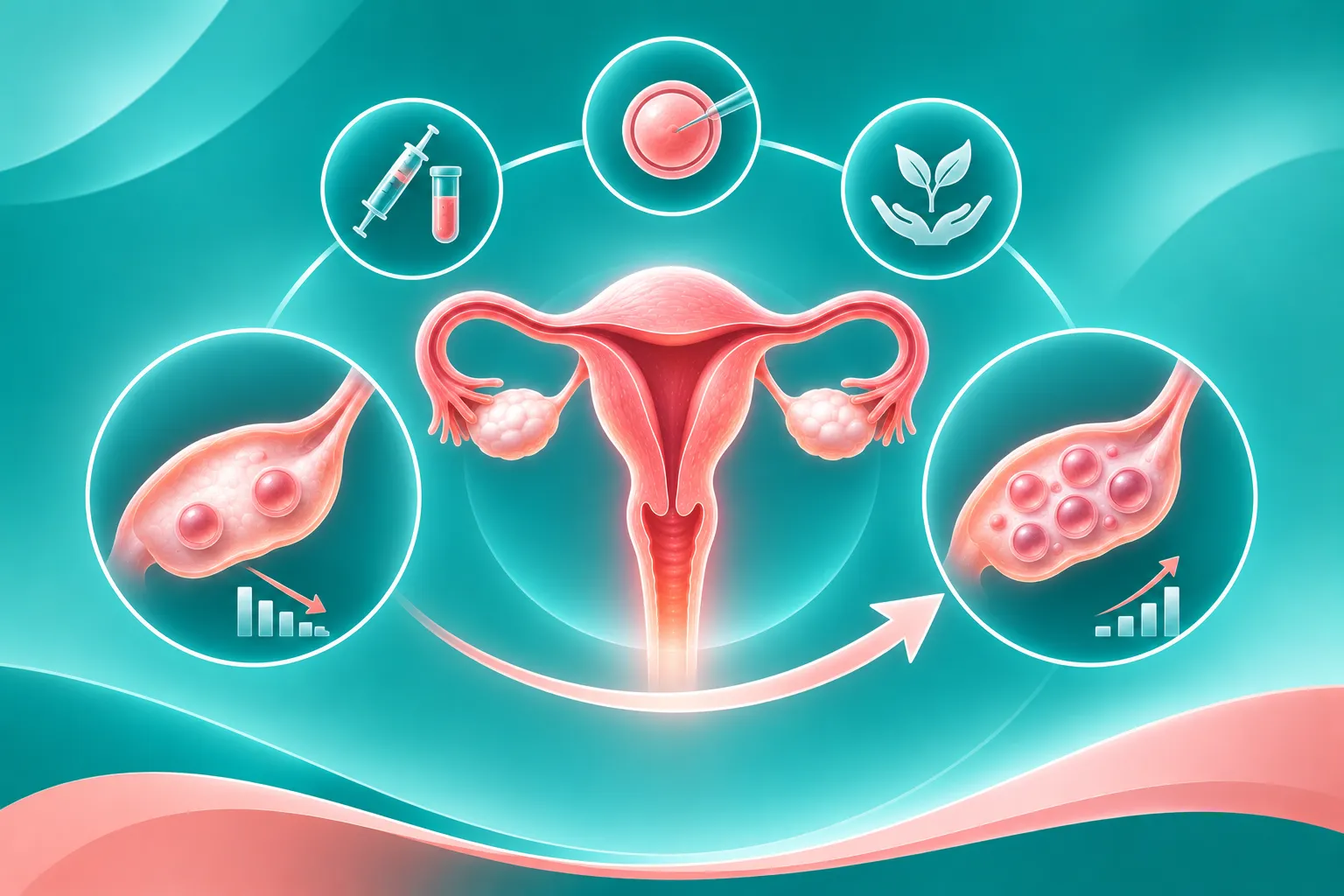
What is ovarian reserve? It is the number of eggs a woman has left in her ovaries. A woman is born with all her eggs, and the number falls with age. A simple blood test measures AMH, which stands for anti Mullerian hormone, to estimate this reserve.
Low AMH means your ovaries hold fewer eggs than expected for your age. Doctors also call this poor ovarian reserve or decreased ovarian reserve. When an anti Mullerian hormone low result comes back, it tells us about egg number, not egg quality, and it does not measure your chance of a healthy baby on its own.
What low AMH means for you
Many women ask what amh low means, or what low amh means, for their chance of a baby. If AMH is low, it usually means fewer eggs are collected in an IVF cycle, so treatment is planned carefully and without delay. It does not mean you cannot conceive. Your age and egg quality matter just as much as low AMH levels.
Low AMH and poor ovarian response
During IVF, women with low AMH can have a poor ovarian response, which means fewer eggs grow with stimulation. An experienced specialist plans the medicines and the timing to make the most of the eggs you have.
Low AMH and Fertility: Can You Still Get Pregnant?
Yes. Low AMH and fertility are linked, but low AMH does not mean you are infertile. Low AMH pregnancy happens for many women, both naturally and with treatment, because it takes only one good egg to conceive. What low AMH does change is time: with fewer eggs, it is wise not to wait too long.
Low AMH at 30 and at other ages
Low AMH at 30 is more common than people expect, and younger women with low AMH often still have good egg quality, which is encouraging. For women in their late 30s and 40s, both egg number and quality fall, so planning sooner gives more options. Your doctor will explain what your result means at your age.
Symptoms of Low AMH
Low AMH often has no symptoms, and many women find out only through a blood test. When there are signs, the symptoms of low AMH can overlap with other hormonal changes. Possible low AMH levels symptoms include:
- Irregular or shortening menstrual cycles
- Lighter or shorter periods than before
- Difficulty conceiving or a failed IVF cycle with few eggs
- Early signs associated with approaching menopause, in some women
Because there are often no symptoms, the only reliable way to know your reserve is a simple test. If you are planning a pregnancy, especially after 30, it is worth checking.
Causes of Low AMH and Poor Ovarian Reserve
There is not always a clear reason, but the common reasons for low AMH and the causes of poor ovarian reserve include:
- Age: the most common reason, as egg number falls naturally over time
- Genetic factors: some women naturally have a lower reserve, sometimes from a young age
- Previous ovarian surgery: for cysts or endometriosis, which can reduce reserve
- Endometriosis: which can affect the ovaries
- Cancer treatment: chemotherapy or radiotherapy
- Autoimmune conditions: in some women
- Unknown causes: when no reason is found
These reasons for low AMH levels and low amh causes are found through your history and a few tests. In many women, low AMH levels causes cannot be pinned to one thing, and that is normal.
Testing: The Best Test for Ovarian Reserve
The best test for ovarian reserve combines two things: the AMH blood test and a pelvic ultrasound scan that counts the small follicles in the ovaries, called the antral follicle count. Together they give a clear picture of your reserve.
| Test | What it checks |
|---|---|
| AMH blood test | Measures the hormone linked to the number of eggs. Can be done any day of the cycle. |
| Antral follicle count (scan) | Counts the small follicles in both ovaries on a scan. |
| FSH and estradiol | Early cycle hormones that add to the picture. |
| Age | Considered alongside the tests, because it reflects egg quality. |
AMH value for IVF
There is no single cut off. Your doctor reads the amh value for ivf planning together with your age and your antral follicle count, then chooses the stimulation plan that suits your reserve. A lower value usually means the plan is adjusted, not that IVF cannot be done.
Low AMH Treatment Options
Low AMH treatment is really about using the eggs you have as well as possible, at the right time. There is no medicine that creates new eggs, so honest, well timed care matters more than any single pill. The low amh levels treatment that suits you depends on your age, your reserve and your reports.
Try sooner, not later
When reserve is low, time matters. For some couples, timed natural attempts or IUI are reasonable first, if the tubes are open and sperm is fine.
IVF planned for low reserve
Low AMH and IVF are often the best match, because IVF makes the most of each egg. The stimulation is tailored so the low amh ivf cycle collects as many good eggs as possible.
Tailored stimulation protocols
Your specialist selects the protocol and doses that give the best ovarian response for your reserve.
Supportive measures
General health, diet and advised supplements may support egg quality, as part of the plan rather than a cure.
Egg or embryo banking
Collecting eggs or embryos over more than one cycle, then using them together, can help when each cycle yields few eggs.
Donor eggs, if and when needed
If your own eggs are very few, donor eggs are an option discussed openly, with counselling, only if it is right for you.
People often ask about the best fertility treatment for low AMH, or the best treatment for low AMH. The honest answer is that the best treatment is the one planned around your reserve, your age and your goals, started without unnecessary delay. Poor ovarian reserve treatment follows the same principle, and a poor ovarian response in an earlier cycle is used to improve the next plan.
Your Low AMH Treatment Journey, Step by Step
Here is what to expect when you come to us with a low AMH result.
Consultation
Dr. Manjunath listens to your history and your result, and explains what it means at your age.
Evaluation
AMH, an antral follicle count scan and other tests give the full picture, and the partner is evaluated too.
Honest plan
You receive a clear plan, realistic chances, the options and an itemised cost.
Treatment
Timely treatment begins, with a protocol tailored to your reserve.
Review
After each step, the plan is reviewed and the next step is agreed together.
Why Choose Dr. Manjunath, a Low AMH Specialist in Bangalore
An experienced low AMH doctor, honest guidance, and treatment planned to make the most of your eggs.
Years of Experience
Fertility care and IVF guided by more than a decade and a half of practice.
Bangalore Clinics
Consult at JP Nagar or Koramangala, whichever is closer to you.
Doctor Throughout
You see the same specialist from your first result to your pregnancy test.
- A named low AMH specialist who plans and leads your care
- Honest guidance on what your result does and does not mean
- Stimulation protocols tailored to a low ovarian reserve
- Timely treatment, because with low AMH time matters
- Egg and embryo banking options where they help
- A transparent, itemised cost estimate before you begin
- Care for how you feel, not just the numbers
- Convenient clinics at JP Nagar and Koramangala
Finding the Best Low AMH Treatment in Bangalore
Search results are full of claims. Whether you are looking for low AMH treatment in Bangalore, the best treatment for low AMH in Bangalore, poor ovarian reserve treatment in Bangalore, a clinic for low AMH or a low AMH specialist in Bangalore, the same checks help you compare fairly. Use them on every clinic, including ours.
If you are searching for low AMH in Bangalore, poor ovarian reserve in Bangalore, a doctor on Low AMH, a doctor on Low AMH in Bangalore or a low AMH doctor in Bangalore, or the best treatment Low AMH in Bangalore, this checklist will help you choose well.
- Honesty first. A good doctor gives realistic chances, never a false promise of success.
- Who treats you. Ask whether the doctor you consult plans and leads your treatment.
- Tailored protocols. For low reserve, the stimulation plan should be chosen for you.
- The right tests. AMH with an antral follicle count gives a clear picture.
- Laboratory quality. Ask about the IVF laboratory, which matters most when eggs are few.
- Clear cost. Ask for an itemised estimate for tests and each treatment cycle.
- Timeliness. With low AMH, a clinic that starts the plan promptly is better than a long wait.
There is no single best clinic for everyone. The best treatment for low AMH in Bangalore is the one planned honestly around your reserve, your age and your goals.
Frequently asked questions
Low AMH means your ovaries hold fewer eggs than expected for your age, which doctors call poor or decreased ovarian reserve. It tells us about egg number, not egg quality, and it does not by itself mean you cannot conceive.
Yes, many women with low AMH conceive, naturally or with treatment, because it takes only one good egg. Low AMH lowers the odds per cycle and means you should not wait too long, but low AMH pregnancy is common.
Low AMH at 30 is more common than people think. The encouraging part is that younger women often still have good egg quality, so with timely care the outlook is frequently good. Your doctor will explain what your result means for you.
There is no medicine that reliably creates new eggs or raises AMH in a lasting way. Good low AMH treatment focuses on using the eggs you have well, at the right time, with a tailored plan.
The best fertility treatment for low AMH depends on your age and reserve. For many women, IVF with a protocol tailored to a low ovarian response gives the best chance, because low AMH and IVF make the most of each egg. Some couples try naturally or with IUI first.
There is no single cut off. Your doctor reads the AMH value for IVF together with your age and antral follicle count, then tailors the stimulation. A lower value usually means the plan is adjusted, not that IVF cannot be done.
The most common cause is age. Other causes of poor ovarian reserve include genetic factors, previous ovarian surgery, endometriosis and cancer treatment. In many women no single cause is found, which is normal.
The best test for ovarian reserve is an AMH blood test together with an antral follicle count on ultrasound. Read with your age, they give a clear picture of your reserve.
Dr. Manjunath provides low AMH and poor ovarian reserve treatment in Bangalore from the JP Nagar clinic, located at [JP NAGAR SHORT ADDRESS], and also consults at Koramangala, located at [KORAMANGALA SHORT ADDRESS]. Call 7899089215 / 9148019966 or use the form to book.
For educational information only; not a substitute for individual medical advice.
.webp)